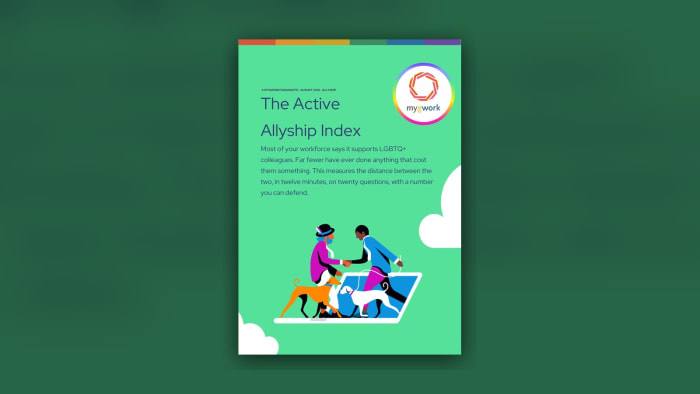
How to Measure Allyship at Work: A 20-Question Diagnostic
September 7, 2026Ask a leadership team whether their organisation supports its LGBTQ+ employees and almost every one of them will say yes. Ask what evidence they would put in front of a sceptic and the conversation changes. Someone mentions the network. Someone mentions the statement. Someone mentions a training completion rate. None of those measure whether anything happens on an ordinary Tuesday, in a room with no photographer in it.
That distance — between what a workforce says it believes and what it has actually done at some cost to itself — is what The Active Allyship Index measures. It is a twenty-question self-assessment, scored out of eighty, and it takes about twelve minutes. It is free, and you can download it at the bottom of this page.
What the Index measures
The twenty questions sit in four dimensions, five questions each, scored from zero to four. The dimensions are deliberately not the ones most DEI dashboards track.
Observable behaviour asks whether allyship shows up in ordinary rooms rather than scheduled ones — whether anyone interrupts a remark, attributes an idea out loud, or turns up to the network meeting that has no catering and no senior guest.
Organisational architecture asks whether your systems produce that behaviour or whether individuals produce it in spite of them. A policy that reads well and a policy that survives contact with a manager who is the problem are two different objects.
Risk and response asks what actually happens when something goes wrong: who hears about it, what the reporting route costs the person using it, and whether anyone senior has ever been visibly held to it.
Load and sustainability asks who is carrying the work and what it costs them. This is the dimension most organisations have never measured, and it is the one that predicts failure most reliably. Inclusion programmes rarely collapse because of hostility. They collapse because four people were doing all of it unpaid, on top of their actual jobs, and two of them left.
Why most organisations land between 25 and 39
Scores fall into five stages. The band from 25 to 39 is called Declarative, and it is both the most common result and the most dangerous one, for a reason that is easy to miss: a Declarative organisation looks like a successful one from the inside.
It has statements. It has an active network. It has a visible presence in June and senior people who will say the right thing when they are asked. What it does not have is any mechanism that produces those behaviours when nobody is asking. Everything good in it is powered by the enthusiasm of specific people, which means it is one reorganisation or one resignation away from a much lower score.
Declarative scores are also stable. They do not quietly decay, and they do not quietly improve. Moving out of the band requires a structural change rather than more goodwill, which is why so many organisations run engagement initiative after engagement initiative and score the same three years running.
The five stages, and what unlocks the next one
- Symbolic (0–24) — the organisation has an intention and nothing that carries it. What unlocks the next stage is a single visible commitment that costs something.
- Declarative (25–39) — the words exist, the machinery does not. What unlocks the next stage is moving one behaviour out of goodwill and into a process someone is accountable for.
- Structured (40–55) — there are systems, and they mostly work when tested. What unlocks the next stage is what happens at the point of failure: whether a complaint about a senior person goes anywhere.
- Integrated (56–68) — inclusion is part of how decisions get made rather than a review applied afterwards. What unlocks the next stage is load: whether the work is resourced, or still volunteered.
- Transformative (69–80) — the organisation would keep producing the behaviour if every current champion left tomorrow.
How to run it so the number means something
Score the organisation, not the intention. The single most common way to waste twelve minutes on this is to score what your organisation would do if the right person happened to be in the room. Score what you could evidence to somebody who did not already believe you.
It is more useful completed in a room than alone, and more useful still when the room contains people who see different parts of the system: someone from HR, whoever leads the network, a senior sponsor, and at least one person with no formal DEI role at all. Where their scores diverge is itself the finding. A sponsor scoring risk and response at three while the network lead scores it at one is not a disagreement about facts — it is a description of who the reporting route is actually built for.
It is worth being equally clear about what the Index is not. It is a self-assessment, not a certification and not a benchmark against other employers. It does not replace asking LGBTQ+ employees directly about their experience, and a good score is not evidence that they are having one. What it does is tell you which of the four dimensions is holding you back, which is a more answerable question than "are we inclusive".
The behaviour half of the problem
The Index measures whether your organisation is built to produce allyship. It does not tell any individual manager what to do on Thursday morning. That is a different problem with a different answer, and it is covered in our companion download: twelve micro-actions, none longer than fifteen minutes, each with the words to use. Start with what to say when a comment lands, or browse our guide to LGBTQ+ inclusive employers by industry and country to see what the higher stages look like in practice.
Download the Active Allyship Index
The full diagnostic is below: all twenty questions, the scoring scale, the five stages with their transition guidance, and a thirty-day list of what to do and what to avoid once you have your number. Score it, then bring the result to us — our partnerships team will read it with you and tell you honestly which dimension to work on first.
The Active Allyship Index is published by myGwork, the global business community for LGBTQ+ professionals, graduates, inclusive employers and anyone who believes in workplace equality.